Gus Hery and NU’s Civilizational Path
Gus Hery calls on Nahdlatul Ulama to move beyond tradition and become a global moral force shaping peace, justice, and civilization.
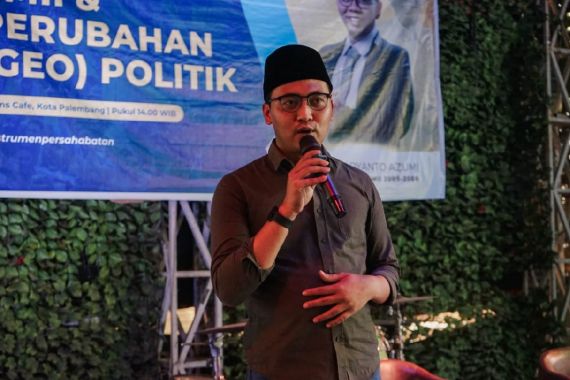
Abdurrohman Wahid, Young Nahdlatul Ulama Intellectual and Entrepreneur.
By Abdurrohman Wahid
(Young Nahdlatul Ulama Intellectual and Entrepreneur)
As Nahdlatul Ulama (NU) enters its second century, the organization faces a defining question: will it remain known primarily as the world’s largest Muslim organization, or will it emerge as a genuine force shaping global civilization?
An organization cannot rely forever on the size of its membership or the glory of its history. Numbers alone eventually become statistics, and historical achievements lose their vitality if they are not transformed into new contributions.
This is the challenge that Gus Hery Haryanto Azumi appears to understand.
For him, NU should not be satisfied with preserving religious traditions within Indonesia. Tradition must evolve into a moral force capable of contributing to global conversations. Islamic boarding schools, or pesantren, should not only educate religious scholars. They should also produce diplomats, global thinkers, economists, technology experts, policymakers, and humanitarian leaders prepared to address international challenges.
The world today does not suffer from a shortage of intelligence. It suffers from a shortage of wisdom.
Wars in Eastern Europe, prolonged conflicts in the Middle East, geopolitical tensions in Asia, refugee crises, climate change, and technological disruption reveal a global order increasingly disconnected from moral principles. International politics is still dominated by military power, economic competition, geopolitical rivalry, and technological supremacy, while humanity itself is too often treated as an afterthought.
In this environment, NU possesses a unique advantage.
Its deep Islamic tradition, Indonesia’s democratic experience, its vast social network, and its commitment to moderation offer something increasingly rare in global affairs: moral credibility.
The principles long embraced by NU—tawassuth (moderation), tawazun (balance), i’tidal (justice), and tasamuh (tolerance)—should no longer remain internal organizational values. They should evolve into ethical principles with global relevance.
Moderation should mean finding common ground without compromising fundamental values. Balance should guide relations between religion, the state, markets, and humanity. Justice must become a firm commitment against oppression. Tolerance should be understood as the ability to live together in an increasingly polarized world.
This is where Gus Hery’s vision gains significance.
Moderation without courage becomes complacency. Tolerance without defending victims becomes an empty slogan. Religious diplomacy without measurable impact risks becoming ceremonial rather than transformative.
NU’s international engagement therefore cannot be limited to conferences, official visits, or symbolic gatherings. Its global network should become a platform for leadership development, humanitarian diplomacy, policy innovation, peacebuilding, and intellectual collaboration between pesantren and international institutions.
The world no longer needs only a peaceful voice of Islam. It needs an Islam capable of offering practical solutions.
That is why the idea of fiqh al-hadarah—or the jurisprudence of civilization—becomes increasingly relevant.
Islamic jurisprudence should not be confined solely to personal religious obligations. It must also engage with pressing global concerns such as armed conflict, economic inequality, environmental degradation, refugee protection, artificial intelligence, corporate power, and international justice.
Religious ethics should once again be closely connected to the realities of human life.
For Gus Hery, civilization is not an abstract concept. It is reflected in concrete solidarity with marginalized communities, societies devastated by conflict, displaced populations, and those deprived of security and opportunity.
This perspective naturally expands the meaning of Islamic brotherhood. Ukhuwah Islamiyah and Ukhuwah Wathaniyah should ultimately lead to Ukhuwah Basyariyah—a universal commitment to defend human dignity simply because every person is human.
Such a shift represents more than an organizational adjustment. It represents a civilizational transformation.
NU has the opportunity to move beyond being merely the world’s largest Muslim organization. It can become a global moral actor capable of shaping international conversations rather than simply participating in them.
Achieving that ambition, however, requires far more than inspirational speeches.
NU needs leaders who understand international law, diplomacy, economics, technology, geopolitics, and multilateral institutions. Pesantren must strengthen partnerships with leading universities worldwide. Nahdliyin living abroad should become strategic contributors in knowledge exchange, humanitarian diplomacy, and social investment rather than remaining peripheral members of the organization.
Initiatives such as the Religion of Twenty (R20) have already opened important doors. Yet opening doors is only the beginning. NU must enter those spaces, build influence, contribute ideas, and leave a lasting legacy.
The world ultimately measures institutions not by the number of conferences they attend, but by the ideas they contribute, the conflicts they help resolve, and the lives they improve.
This explains why Gus Hery Haryanto Azumi deserves attention—not merely as a potential leader within NU, but as someone advocating a broader vision of leadership that bridges tradition with innovation, Indonesia with the world, and religious identity with global responsibility.
His central message is both simple and profound: NU is too significant to remain preoccupied with itself.
If NU continues to focus primarily on internal competition, it risks missing a historic opportunity. But if it transforms its rich traditions into global contributions, Indonesia’s largest Islamic organization can also become one of the world’s most influential moral voices.
NU has long been a major force in Indonesia. The challenge now is ensuring that its values become meaningful far beyond Indonesia’s borders. (*)