Suyudi’s Leadership Test: Police Reform and the Shadow of Internal Sabotage
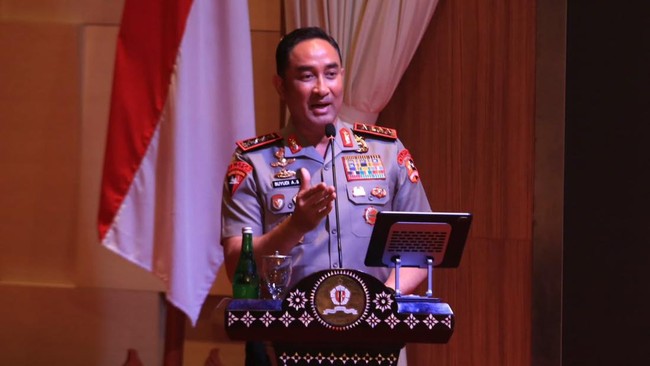
Indonesia’s new National Police Chief, General Suyudi Ario Seto. (Photo: Doc.Polri)
By Samsul Muarif *)
There is an irony in institutional reform. When a new leader arrives promising change, an organisation’s long-standing weaknesses often become more visible than ever. Not necessarily because the new leader has failed, but because reform never takes place in a vacuum. It must contend with entrenched cultures, vested interests, established habits and existing power structures.
The police raid on Pondok Pesantren Hamalatul Qur’an in Mojolaban, Sukoharjo, Central Java, has become an early and serious test for Indonesia’s new National Police Chief, General Suyudi Ario Seto. The operation was linked to an investigation into the burning of and damage to a pork noodle shop. What should have been a routine law enforcement operation, however, has sparked widespread controversy involving human rights, child protection, religious sensitivities and public trust in the police.
The controversy is particularly sensitive because it comes at a moment when the National Police, or Polri, is entering a new leadership era, raising expectations of a more approachable, fairer and service-oriented institution.
Suyudi has introduced the vision of Polisi Bersama Masyarakat—the police working alongside the people. His initial agenda has emphasised better public services, fair law enforcement, internal consolidation, and institutional and human resource reform. He has also pledged to strengthen meritocracy, oversight and accountability.
His proposal to move beyond measuring police performance by the number of cases handled, towards assessing the legality, evidentiary quality and fairness of law enforcement, deserves particular recognition.
At a time when public confidence in the police remains fragile, this direction offers grounds for hope. But hope cannot rest on programmes and public statements alone. It must be tested against the real experiences of citizens when they encounter the police.
When Justice Loses Its Human Face
According to accounts that have drawn public attention, the search of the pesantren took place in the early hours of the morning and involved armed officers. The pesantren’s representatives have alleged intimidation, inappropriate treatment of female students, and irregularities in the examination and seizure of belongings. Several occupants, including children, were reportedly taken to a police station.
On November 1, 2026, Indonesia’s National Commission on Human Rights (Komnas HAM) called for an independent examination of alleged procedural violations, the use of excessive force, and possible irregularities in the search and seizure. It also called for an audit of the legal basis and validity of the search authorisation, as well as remedies for affected residents.
This is no longer merely a public relations problem. It raises a fundamental question about how the state exercises its authority.
The police have a duty to investigate the arson and property damage. Violence against anyone, including businesses targeted because of religious differences or identity, must not be tolerated. A pesantren is not beyond the reach of the law. If suspects are believed to be sheltering there, the investigation must proceed in accordance with the law.
But the legitimacy of law enforcement cannot be measured solely by the number of suspects apprehended. It also depends on how an operation is conducted, how people are treated, and whether the rights of those unconnected to the case are respected.
This is where the line between firmness and arbitrariness becomes crucial.
The use of force must be based on genuine necessity and identifiable threats, not simply tactical convenience or a show of strength. The presence of children, women, boarding students and people unrelated to an investigation should be central to operational planning.
If the allegations of intimidation and inappropriate treatment of female students are substantiated, the matter cannot be dismissed as a technical mistake. It concerns human dignity and institutional responsibility.
Should We Suspect Internal Sabotage?
Amid the controversy, some observers have suggested that the incident may reflect internal decay within the police, or even an attempt to undermine Suyudi’s leadership.
The hypothesis is worth examining, particularly because a new leadership is seeking to build public expectations of change. Suyudi has promoted a more people-centred approach, attracted attention among religious communities and offered a programme of internal reform. An operation that provokes public anger can clearly damage the trust his leadership is trying to build.
Yet we must resist the temptation to leap from consequence to intent.
The fact that an incident damages the National Police Chief’s reputation does not, by itself, prove that it was designed to weaken him. Reputational damage can result from many causes: poor planning, inadequate supervision, an unhealthy command culture, or deliberate misconduct.
The possibility of internal sabotage should not be ruled out. But neither should it become an automatic explanation.
At least three possibilities warrant examination.
First, the operation may have gone wrong because of weaknesses in professionalism, planning and oversight.
Second, there may be resistance to change within the organisation, expressed through bureaucratic inertia, entrenched practices or non-compliance with new standards.
Third, individuals may have deliberately created or allowed a crisis to serve particular interests.
Each possibility demands a different investigative approach.
The central questions should not be who might dislike the National Police Chief, but who planned the operation, what information was available, who authorised key decisions, how instructions were implemented, and whether any deviations were deliberate.
Did field commanders know that the premises housed female students and children? Were safer alternatives considered? Were warnings ignored? Did the actual operation differ from the approved plan? How was the initial report conveyed to senior leadership?
Answers to these questions would be far more useful than speculation about factions or internal networks for which evidence has yet to be established.
If sabotage occurred, it must be demonstrated through evidence. If the incident stemmed from professional failure or institutional resistance, those causes must be identified and addressed just as seriously.
Leadership Alone Cannot Reform an Institution
One of the greatest challenges in police reform is the tendency to place excessive faith in the individual at the top. A good police chief, it is often assumed, will automatically produce a good police force.
But an institution as large and complex as Polri cannot be transformed simply by changing its leadership.
Organisational scholar Edgar Schein has shown how organisational culture operates through underlying assumptions, values and habits that are often invisible but powerfully shape behaviour. In policing, these cultural patterns can determine whether officers feel safe admitting mistakes, whether criticism is treated as constructive feedback or a threat, and whether success is measured by public service or merely operational targets.
When leadership changes without a corresponding shift in organisational culture, reform risks becoming a paradox: the language changes, but the way the institution works remains the same.
The work of Tom R. Tyler, a leading scholar of procedural justice at Yale Law School, is particularly relevant here. His research highlights how people’s perceptions of procedural fairness help shape the legitimacy of authority and their willingness to cooperate with law enforcement.
People do not judge the police solely by the outcome of an operation. They also judge whether they were treated with respect, whether decisions were explained, whether procedures were fair and whether officers acted impartially.
Trust cannot be built through slogans about being close to the community. It grows through repeated experiences in which people feel heard, protected and treated equally.
This is why Polisi Bersama Masyarakat could become a meaningful vision—but only if it leads to systemic change rather than serving as a communications identity for a new leadership.
Suyudi’s leadership deserves room to demonstrate the substance of its reform agenda. Institutional consolidation, improved public services, merit-based personnel management, stronger oversight and the elimination of transactional practices in recruitment and career advancement are important priorities.
His proposal to strengthen local police stations (Polsek) as the frontline of public service also holds promise, provided it is supported by adequate authority, competent personnel, accessible complaint mechanisms and transparent performance assessments.
The same applies to the proposed shift in how law enforcement success is measured. For too long, police performance has too easily been associated with the number of cases solved, arrests made or operations conducted.
The quality of evidence, procedural compliance, victim protection, legal certainty and substantive justice should matter far more.
Precisely because these reforms are worthwhile, the Sukoharjo incident should become a moment to put them to the test.
Accountability Must Go Beyond Damage Control
The National Police Chief must ensure that the examination of this incident does not end with a public clarification or communications management.
The Professional and Security Division of the National Police (Propam) should investigate the allegations independently and professionally within its mandate. The National Police Commission (Kompolnas) and Komnas HAM should be given the necessary space to carry out their respective oversight functions.
The review should examine the chain of command, the legal basis for the operation, its planning, the use of force, the procedures for questioning individuals and the seizure of property.
Findings should be disclosed in a proportionate and credible manner, while safeguarding witnesses, affected individuals and the integrity of the ongoing investigation.
Where violations are established, sanctions must be applied consistently. If criminal conduct is indicated, the legal process must follow. Conversely, if particular allegations are not substantiated, the explanation should be supported by evidence and reasoning that can withstand scrutiny.
Equally important, remedies for affected students and residents should not wait until public controversy subsides.
Psychological support, continuity of education, the return of property unrelated to the investigation, and assurances against intimidation deserve immediate attention.
Accountability is not merely about punishing wrongdoing. It is also about repairing harm and preventing its recurrence.
Reform Must Be Measurable
One danger must be avoided: treating criticism of this operation as proof that the entire police institution has failed.
Many police officers serve with integrity, put their safety at risk and deliver meaningful services to the public. Recognising their work does not mean turning a blind eye to misconduct. On the contrary, addressing violations protects professional officers from reputational damage caused by the actions of a few or by systemic failures.
Suyudi’s constructive engagement with Islamic figures and pesantren leaders can also provide a valuable foundation for social dialogue. But these relationships must never translate into privileges for particular communities.
The police must protect all citizens equally, including religious minorities, people of different beliefs, and those without access to influential figures or political power.
The investigation into the burning of the pork noodle shop must proceed. The rights and dignity of pesantren residents must also be protected. These are not competing interests.
Looking ahead, Polri needs a more measurable system for evaluating high-risk operations. Every such operation should include a civilian safety assessment, child-protection protocols, proper documentation of the use of force, and a post-operation review.
Performance indicators could include public complaints, resolution times, substantiated violations, remedies provided to victims and the implementation of corrective measures.
Oversight, too, must move beyond reacting to incidents after they become viral. Risk-based prevention should become a routine part of police management.
The ultimate test of Suyudi’s leadership is not whether he can contain a controversy or preserve his popularity. It is whether he can build an institution that remains professional when no one is watching, humane when circumstances become difficult, and accountable when wrongdoing occurs within its own ranks.
If internal sabotage exists, it must be proven and exposed through lawful mechanisms. If the problem is systemic weakness, the system itself must be repaired. And if violations are established, justice must be served regardless of rank.
Police reform cannot be the personal project of a National Police Chief. It must become a lasting compact of trust between the institution and society.
For a strong police force is not one that inspires the greatest fear. It is one whose authority commands respect because its conduct is fair, whose presence people value, and whose integrity they can trust.
*) Samsul Muarif is the author of Polisi Era Kini (2018) and is currently writing Polisi Rakyat: Suyudi and a New Path for Police Transformation in Indonesia.