Indonesia Urges Indian Ocean Nations to Put People Before Geopolitical Rivalries
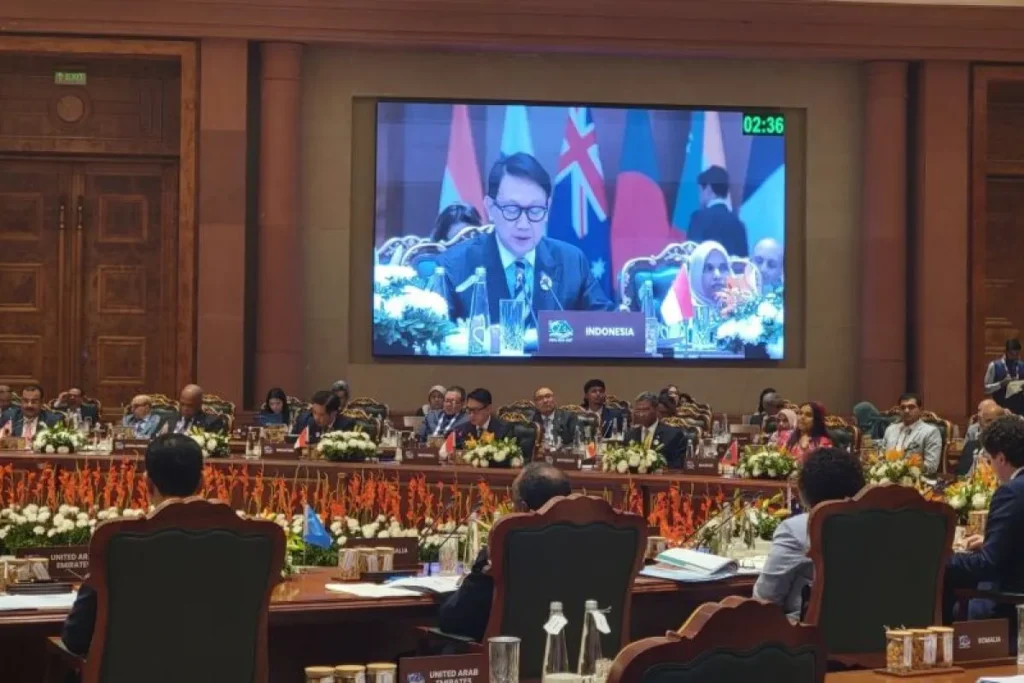
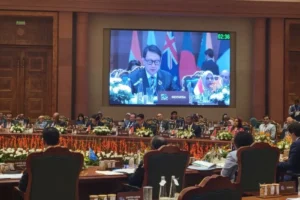
Indonesia’s Deputy Foreign Minister Arif Havas Oegroseno speaks during a general debate session titled “A Stronger Regional Voice: Positioning IORA in a Changing Global Order” at the IORA Council of Ministers Meeting in New Delhi, India, on November 25–27, 2026. (Photo: Indonesia’s Ministry of Foreign Affairs)
BORDER JOURNAL — Indonesia has called on Indian Ocean countries to look beyond geopolitical competition and place the interests of coastal communities at the centre of regional cooperation.
Deputy Foreign Minister Arif Havas Oegroseno delivered the message at the Indian Ocean Rim Association (IORA) Council of Ministers Meeting in New Delhi, India, held from November 25 to 27, 2026.
“From the perspective of strategic planners, the Indian Ocean is an arena of competition. But for our communities, the Indian Ocean is home,” Havas said during a general debate session titled “A Stronger Regional Voice: Positioning IORA in a Changing Global Order,” according to a statement from Indonesia’s Ministry of Foreign Affairs.
His remarks highlighted Indonesia’s position that the Indian Ocean should not be viewed solely through the lens of strategic rivalry. Millions of people across the region depend on its waters for livelihoods, food security, trade and economic activity.
To strengthen regional cooperation, Havas outlined five priorities for IORA member states.
The first is respect for international law, particularly the United Nations Convention on the Law of the Sea (UNCLOS) and the Biodiversity Beyond National Jurisdiction (BBNJ) Agreement. Indonesia also emphasised responsible freedom of navigation, restraint among states, marine environmental protection and cooperation in responding to maritime incidents.
Second, countries need to safeguard energy routes. Disruptions to major shipping corridors can have consequences far beyond the maritime sector, potentially affecting fuel supplies, food distribution and prices.
Third, IORA should strengthen collective efforts to protect coastal communities from marine pollution. This requires better preparedness and coordinated responses among countries sharing the Indian Ocean.
The fourth priority concerns resilience to climate-related and marine disasters. Havas highlighted the importance of early-warning systems, evacuation preparedness, coastal restoration and access to adaptation financing.
Fifth, Indonesia called for fair and accountable fisheries governance. This includes transparent fishing access, stronger conservation measures and equitable treatment of coastal states.
Indonesia and Mozambique Explore Cooperation
On the sidelines of the meeting, Havas held talks with Mozambique’s Deputy Foreign Minister Maria de Fátima Simão Manso. Their discussions covered potential cooperation in capacity building, education, energy, vaccines and healthcare.
The two officials also discussed efforts to secure support for Indonesian Health Minister Budi Gunadi Sadikin’s candidacy for Director-General of the World Health Organization (WHO) for the 2027–2032 term.
IORA provides an important platform for advancing these priorities. Established in 1997, the organisation has 23 member states representing approximately 2.5 billion people, or nearly 31 percent of the global population. Its combined gross domestic product is estimated at around US$11 trillion.
The Indian Ocean region also has considerable economic importance for Indonesia. Trade between Indonesia and IORA member states reached US$127.41 billion in 2025, accounting for nearly a quarter of the country’s total trade. Singapore, Malaysia and India were Indonesia’s three largest trading partners within the association.
Indonesia was among IORA’s founding members. In 2017, it chaired the organisation and hosted its first IORA Leaders’ Summit in Jakarta, which produced the Jakarta Concord.
The agreement set out a vision of a peaceful, stable and prosperous Indian Ocean region based on international law, including UNCLOS 1982, and the principle of non-interference.
Indonesia’s latest proposals underline a broader message: regional cooperation should deliver practical benefits to the people who depend on the Indian Ocean, rather than allowing strategic competition to define the region’s future.
(***)