Indonesia Rules Out Javan Rhino Relocation Without Scientific Evidence as Alas Purwo Plan Faces Scrutiny
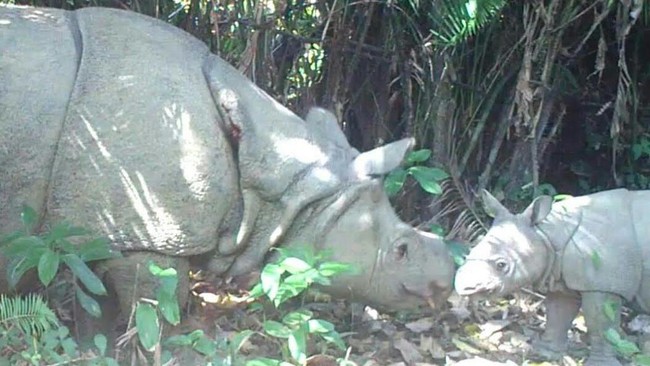
Indonesia’s government has stressed that it will not move Javan rhinoceroses from Ujung Kulon National Park in Banten to Alas Purwo National Park in East Java until comprehensive scientific assessments confirm that the proposed destination can support the endangered species. (Photo: RMU)
BORDER JOURNAL — Indonesia’s government has stressed that it will not move Javan rhinoceroses from Ujung Kulon National Park in Banten to Alas Purwo National Park in East Java until comprehensive scientific assessments confirm that the proposed destination can support the endangered species.
The clarification follows growing discussion over plans to establish a second habitat for the Javan rhino (Rhinoceros sondaicus), whose entire remaining wild population lives in Ujung Kulon. The proposal aims to reduce the risk of extinction from natural disasters, particularly a tsunami triggered by seismic or volcanic activity around the Sunda Strait.
Muhamad Hidayat, a senior expert at the Government Communication Agency (Bakom RI), said on Tuesday, November 17, that Alas Purwo remained a potential location rather than an approved relocation site.
“Ujung Kulon remains the Javan rhino’s primary home and must continue to be protected. Alas Purwo can only be considered as a second habitat if all ecological and security requirements are proven through scientific studies. Without that evidence, relocation will not take place,” Hidayat said in a statement.
He emphasized that the government would not rush into a decision that could put the animals’ survival at risk. Any assessment must establish whether the proposed habitat can provide sufficient natural food throughout the year, reliable water sources, wallowing areas, adequate roaming space and effective protection.
Researchers must also examine possible conflicts with surrounding communities and competition for natural resources with other wildlife, particularly banteng, or Javan wild cattle.
“The safety of every individual Javan rhino is our priority. No relocation will take place before scientific studies confirm the availability of food, water, wallowing sites, roaming space and habitat security,” Hidayat said.
Disaster Risks Drive Search for a Second Habitat
The relocation proposal gained renewed attention after Hashim Djojohadikusumo, the President’s Special Envoy for Climate and Energy, raised the idea at the COP31 climate conference in Antalya, Türkiye, on November 12.
Hashim warned that a major tsunami linked to an earthquake or volcanic eruption near Anak Krakatau could devastate the rhino population if all remaining animals continued to depend on a single location.
“If there is a tsunami due to an earthquake or volcanic eruption, our Javan rhinos could become extinct. That is why there is an idea to move some of them to Alas Purwo,” Hashim said, as reported by Indonesian media.
He also indicated that conservation financing could help fund the development of a second habitat, with the government seeking interest from potential international donors and investors.
Indonesia’s House of Representatives (DPR) has also signalled its intention to examine the proposal. Deputy Speaker Saan Mustopa said Commission IV, which oversees forestry and related sectors, would be asked to discuss the matter with relevant government partners.
“The DPR will ask Commission IV to discuss and examine this issue with the relevant partners,” Saan told reporters at the parliamentary complex in Jakarta on Tuesday.
Why Ujung Kulon Remains Critical
Ujung Kulon has served as the Javan rhino’s last natural refuge for decades. UNESCO identifies the national park as the species’ only remaining natural habitat and recognizes its extensive lowland rainforest as globally significant.
Population estimates vary by source. The IUCN Species Survival Commission’s Asian Rhino Specialist Group reported in February 2026 that fewer than 50 Javan rhinos remained. Bakom, meanwhile, has described the population as fewer than 100.
The park offers a combination of lowland tropical rainforest, diverse vegetation, rivers, mud wallows and relatively open areas. These features are important for a species that feeds on young shoots, leaves, twigs and fallen fruit.
A 2013 study published in the Journal of Tropical Forest Management by researchers from Bogor Agricultural University (IPB) found that Javan rhinos frequently used swamp shrubs and open shrubland, particularly areas near rivers and wallowing sites.
UNESCO also records 29 other mammal species and more than 270 bird species in the Ujung Kulon World Heritage site.
The challenge, therefore, is not simply finding another forest. A second habitat must provide the ecological conditions needed for a viable population while ensuring protection from poaching, disease and human-wildlife conflict.
For now, the government says conservation patrols and protection efforts in Ujung Kulon will remain a priority. Any decision involving relocation will depend on scientific evidence and expert recommendations, rather than the urgency of the proposal alone.
(***)