
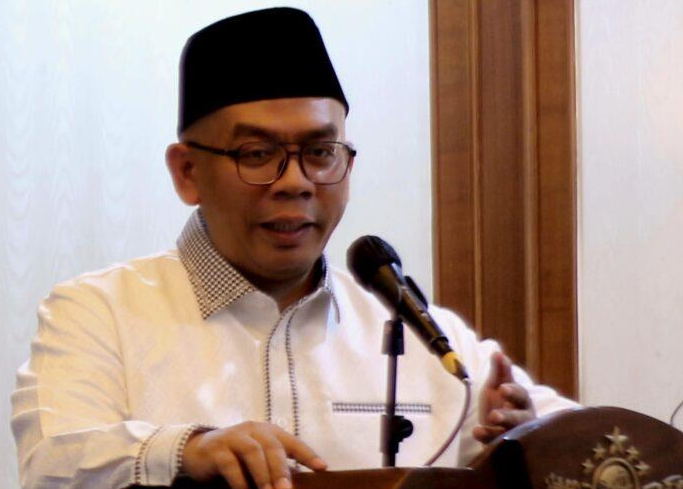
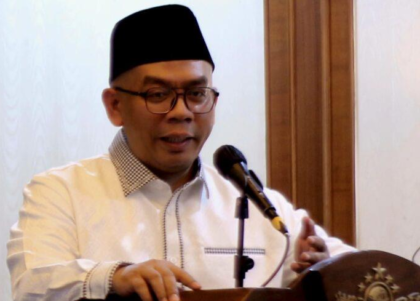
By Hery Haryanto Azumi
Initiator, the New Awakening Movement of Nahdlatul Ulama (GKB-NU); Former Chairman of the Indonesian Muslim Student Movement (PMII); Former Deputy Secretary-General of Nahdlatul Ulama (NU)
BORDER JOURNAL — Indonesia’s participation in the Board of Peace has triggered public controversy. Critics worry that Jakarta could be drawn into legitimizing Israeli interests, particularly in the aftermath of the Gaza war. Some civil society organizations have even urged Indonesia to withdraw altogether.
These concerns are understandable. Indonesia has a long and principled history of supporting Palestinian independence, and any diplomatic move that appears to dilute this commitment deserves scrutiny. However, withdrawing from the Board of Peace would be a strategic mistake. From the perspective of the New Awakening Movement of Nahdlatul Ulama (GKB-NU), Indonesia’s presence inside this forum is not a liability — it is a strategic asset in the struggle for a just and lasting peace.
Multilateral Engagement, Not Political Endorsement
The Board of Peace is not an informal political club. It is a mechanism derived from United Nations Security Council Resolution 2803, adopted following the Hamas–Israel ceasefire. Indonesia’s participation should therefore be understood as a multilateral responsibility, not an ideological alignment.
Indonesia is not there to legitimize occupation or injustice. It is there to ensure that post-war reconstruction and stabilization are conducted fairly, inclusively, and in line with international law. Abandoning the table would not weaken Israel’s position; it would only weaken the voice of Palestine and the Global South within the process.
Reconstruction Must Serve the Two-State Solution
Under the current framework, the Executive Committee of the Board of Peace works alongside the National Committee for the Administration of Gaza (NCAG) — a Palestinian technocratic body mandated to administer Gaza for a two-year transitional period. Its authority extends across both previously Hamas-controlled areas and zones formerly under Israeli control.
To maintain public order, an International Stabilization Force (ISF) supports Palestinian police forces currently undergoing training in Jordan and Egypt. This architecture, while imperfect, creates a narrow but real opportunity: reconstruction that does not detach Gaza from the broader political horizon of Palestinian statehood.
Indonesia’s role is crucial here. As the world’s largest Muslim-majority democracy with an unbroken record of support for Palestine, Indonesia carries both moral credibility and political leverage to insist that Gaza’s rehabilitation remains firmly anchored to the Two-State Solution.
Peace without sovereignty is not peace — it is postponement.
Security and Justice Must Move Together
The ceasefire framework contains two inseparable conditions: the disarmament of Hamas in designated zones and the withdrawal of Israeli Defense Forces from others. These steps are not concessions; they are mutual prerequisites for a reconstruction process that does not reproduce the cycle of violence.
Indonesia’s participation allows it to press for balance: security for all civilians, Israeli and Palestinian alike, alongside irreversible steps toward Palestinian independence. This balance reflects Indonesia’s long-standing Free and Active (Bebas Aktif) foreign policy and its non-aligned tradition.
President Prabowo and Strategic Continuity
GKB-NU believes President Prabowo Subianto has the capacity to navigate this delicate terrain. His consistent emphasis on non-bloc diplomacy signals continuity rather than rupture in Indonesia’s foreign policy compass.
Indonesia has not lost its direction. Its commitment to a free, sovereign Palestinian state remains final and non-negotiable. The Board of Peace should be seen precisely as a strategic arena in which that commitment can be defended — firmly, visibly, and constructively.
Public Trust and Diplomatic Space
Diplomacy requires room to operate. Excessive suspicion risks undermining Indonesia’s effectiveness before the mission has fully unfolded. Public vigilance is necessary, but it must be accompanied by strategic patience.
Beyond the Board of Peace, Indonesia’s growing engagement in global forums — whether through BRICS or de-escalation initiatives involving Iran, Israel, and the United States — reflects a confident, outward-looking posture befitting a major actor in a multipolar world order.
Civil Society and Track-Three Diplomacy
As part of its concrete contribution, GKB-NU will strengthen track-three diplomacy—people-to-people engagement through civil society networks. NU’s transnational religious, educational, and humanitarian ties, built over decades, are a form of soft power that can humanize diplomacy and reduce mistrust where formal channels fall short.
Peace is not achieved by governments alone. It is sustained by societies willing to imagine coexistence.
Peace Is Not a Slogan
Indonesia’s seat at the Board of Peace is not an abandonment of Palestine. It is a test of whether moral commitment can be translated into effective diplomacy.
Peace is possible — but only if justice is kept at its core. And justice, for Palestinians, means independence.
Peace is not a slogan. It is the most realistic path forward for humanity.
(***)








Komentar