NU at a Crossroads: Conflict, Politics, and the Test of Wisdom
NU is too large, too precious, and too noble to be sacrificed to short-term ambition.
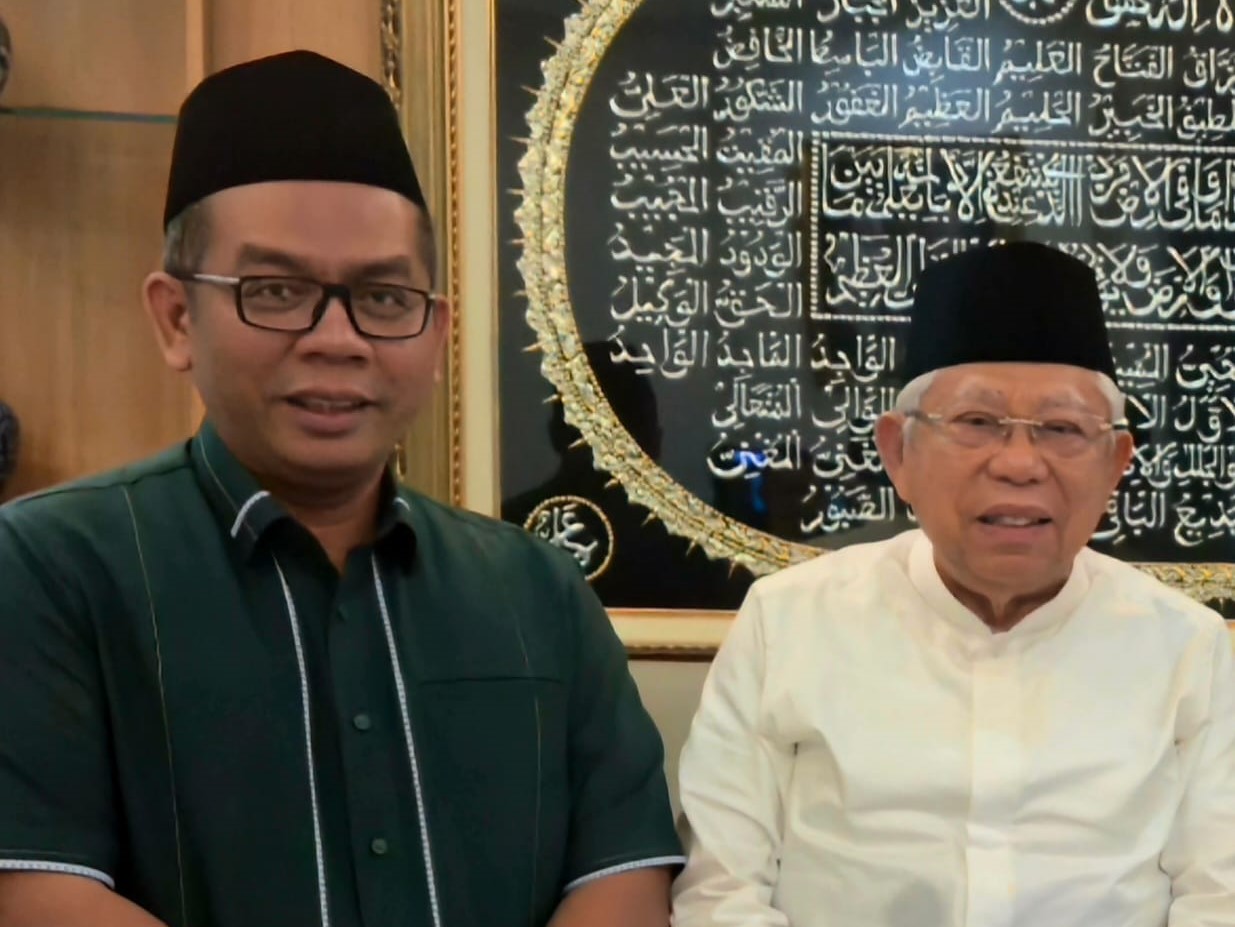
Hery Haryanto Azumi (left) alongside former Indonesian Vice President KH. Ma’ruf Amin. (Photo courtesy of the author)
By Hery Haryanto Azumi
(Former Chairman of PMII, the youth organization affiliated with Nahdlatul Ulama (NU), and former Deputy Secretary-General of NU. The views expressed here are solely those of the author)
Nahdlatul Ulama (NU) stands today at one of the most critical junctures in its long history. I write this not as an external observer, but as someone who has spent decades within NU—as a cadre, an organizer, and a witness to its internal dynamics. What is unfolding now is not merely an organizational dispute. It is a profound test of NU’s moral authority, political maturity, and historical responsibility.
Internal conflict is not new to NU. Since its founding, NU has lived with differences of opinion and internal contestation. Yet the current crisis is unprecedented in its openness and intensity. For the first time in recent history, two rival groups simultaneously claim to be the legitimate Executive Board of Nahdlatul Ulama (PBNU). This dualism is no longer a latent tension; it is a public rupture that risks undermining NU’s credibility as a moral anchor of Indonesian Islam.
Beyond Organizational Procedure
Some have framed this crisis as a technical dispute over statutes and procedures. Such explanations are insufficient. What NU faces today goes far deeper: it concerns the legitimacy of ulama leadership, the ethics of power, and NU’s direction as it enters its second century.
Scholars such as Greg Barton have long emphasized that NU is not simply a religious organization, but a moral force and a social movement with enormous political weight. With an estimated 110 million followers—nearly half of Indonesia’s electorate—NU is inevitably entangled in national politics. As the 2029 presidential election approaches, the political undertones of this conflict have become increasingly difficult to ignore. NU is seen not only as a religious authority, but also as a potential kingmaker.
Yet NU’s greatness lies precisely in its ability to rise above short-term political calculations. When internal conflicts are driven—or perceived to be driven—by political ambition, NU risks losing the moral distance that has long been the source of its authority.
The Shadow of the Lampung Congress
Many within NU believe that the roots of today’s crisis can be traced back to the 34th NU Congress in Lampung. The issue is not simply who won or lost, but the widespread perception that the process was forced and insufficiently inclusive. In any large organization, decisions made without a strong sense of collective justice tend to generate long-term resentment.
What we see today may well be the accumulation of that unresolved discontent. The current conflict should therefore not be reduced to a clash of personalities. It reflects a deeper unease about how power is exercised within NU and how faithfully the organization adheres to its own ethical traditions.
Two PBNU, One Community
The existence of two parallel PBNU structures—each claiming legitimacy and commanding significant support—poses a serious threat to NU’s unity. NU is not a political party that can simply split into competing factions. It is a jam’iyyah diniyyah ijtima’iyyah: a shared home for ulama and millions of ordinary believers.
As Indonesian journalist Dahlan Iskan observed, this split resembles cutting open a watermelon rather than a durian—both halves look equally fresh and legitimate. That is precisely what makes the current crisis so dangerous. The longer it persists, the deeper the confusion and disillusionment among grassroots members.
Mining Concessions and Ulama Ethics
One of the most contentious issues in this conflict concerns mining concessions granted to NU-linked entities. Supporters argue that such concessions could provide NU with long-term financial independence, freeing it from chronic dependence on donations and political patrons.
This argument, however, collides with serious ethical concerns. Former PBNU chairman KH Said Aqil Siradj has publicly warned that mining concessions may bring more harm than benefit, citing religious deliberations (bahtsul masail) that even classify them as impermissible. His position is a reminder that financial independence cannot come at the cost of moral authority. When senior ulama are directly involved in extractive industries, the line between religious leadership and worldly power becomes dangerously blurred.
A pragmatic middle path remains possible. If such concessions are maintained, they must be managed professionally, transparently, and at arm’s length from NU’s top leadership. If, however, social, environmental, and moral harms outweigh the benefits, returning these concessions to the state may better serve NU’s long-term credibility.
A Way Out: An Extraordinary Congress
In the current deadlock, the idea of an Extraordinary Congress (Muktamar Luar Biasa) deserves serious consideration. Such a congress is not a sign of failure, but a constitutional mechanism to restore legitimacy by returning decision-making authority to NU’s grassroots.
For this option to succeed, all parties must exercise restraint, refrain from mobilizing organizational muscle, and uphold the ethical standards expected of a religious institution. If conducted honestly and inclusively, an extraordinary congress could provide a peaceful exit from the crisis.
Senior Ulama, Young Cadres, and the Future
NU’s strength has always rested on the moral wisdom of its senior ulama and the dynamism of its younger cadres. Today, senior kiai bear a particular historical responsibility. As their knowledge and experience deepen, so too should their self-restraint. Open competition for positions and material interests risks eroding the moral example that ulama are meant to embody.
At the same time, NU possesses a vast reservoir of capable young cadres—religiously grounded, socially engaged, and globally literate. Opening greater leadership space for this generation, while positioning senior ulama as moral guides and mediators, is essential if NU is to thrive in its second century.
The Role of the State
The Indonesian state must tread carefully. Heavy-handed political intervention would only intensify internal divisions and reinforce suspicions of politicization. The most constructive role the government can play is to facilitate dialogue, ensure security, and respect NU’s internal processes.
A united and dignified NU is far more valuable to national stability than a fragmented NU vulnerable to manipulation.
Toward NU’s Second Century
This crisis should serve as a moment of collective introspection. NU has entered its second century with immense moral capital and social influence. Whether it emerges from this conflict weakened or renewed will depend on the wisdom of its leaders.
NU is too large, too precious, and too noble to be sacrificed to short-term ambition. The path forward lies in restoring ethical leadership, reaffirming collective legitimacy, and returning to NU’s founding spirit: serving the ummah, the nation, and humanity at large.
December 16, 2025